High-speed Digital Printing Machine Technology for Commercial Printing
High-speed Digital Printing Machine technology for commercial printing means plate-free production systems that send a digital file straight to the substrate. Shops can then run short, personalized, and multi-version jobs without plate making, exposure, or long setup. A High-speed Digital Printing Machine performs best when its job mix, color accuracy, media range, and operating cost match the production plan. In this guide, I explain how the technology works, which specifications matter, and how to compare suppliers. I also describe the Shanghai Honghua roll-to-roll label system and what U.S. buyers should check before ordering.
What Is a High-speed Digital Printing Machine and How Does It Work?
Plate-Free Workflow From File to Finished Roll
A digital press reads a prepared file and prints on the material based on the information in it. The normal method goes through preflighting the file, RIP processing, applying the ink, curing, ending, and inspecting. The shop skips making and exposing plates because there isn't a physical plate. Designers can send artwork straight to the press because our system works with TIFF, PDF, and other similar file types. When you change from one label design to another, you don't have to change plates; you just change files. With customized, small-lot, and multi-version orders, plate costs and setup time often take up a big chunk of the budget for each job.
Inkjet, Toner, and Offset Compared
There are two main image methods used in digital creation. With an inkjet, tiny drops of ink are fired from the printhead onto the substrate. This method can be used on both paper and film labels. Toners use heat to stick dry powder to the surface and can be used for many sheet-fed jobs. With an offset press, ink moves from plates to a cover, and the press can keep working well for very long runs of the same pattern. Inkjet is best for labels because it can print different things and switch between jobs quickly. CMYK four-color inkjet is used in our label press, which can print most brand labels and stickers.
Roll-to-Roll Configuration for Labels
A roll-to-roll layout is best for making labels. The machine unwinds the roll, prints on it, lets the ink dry, and then winds the roll back up again. Our system can work with rolls that are up to 800 mm in diameter and 75 mm to 350 mm wide. It can also work with materials that are 0.02 mm to 1 mm thick. The widest you can print is 322 mm. Stickers, self-sticking labels, brand labels, and color roll printing can all be done on it. It also allows secondary printing on both the front and back in any color, so artists can add a second pass over the first.
High-speed Digital Printing Machine Performance Specifications
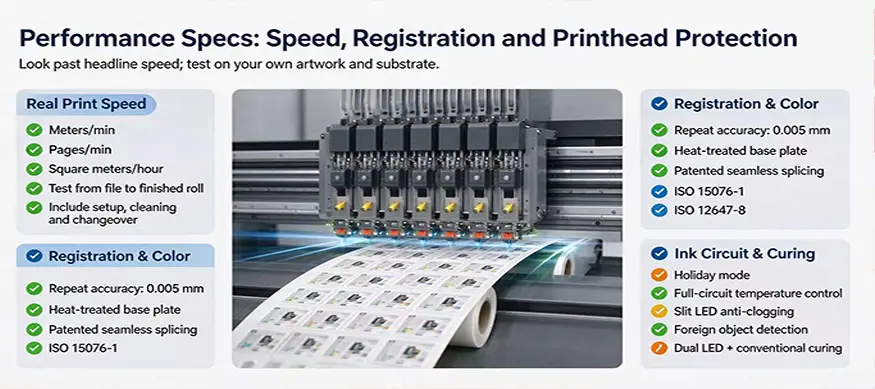
Judge Output, Not Only Rated Speed
There are different ways to measure speed, like meters per minute, pages per minute, or square meters per hour. A headline number rarely shows how much work was done. How fast something can be printed depends on the paper, the ink, the resolution, the curing time, the roll changes, and the finishing. I tell buyers to ask for a sample run with their own artwork and substrate, and then they should time the whole job, from the file to the finished roll. That test also tells you how often you need to be an engineer. Customers are welcome to try with their own files first, since live samples show more than just a brochure number.
Registration, Color Control, and Machine Build
Registration determines whether signs with more than one color look clear on a High-speed Digital Printing Machine. The printing tool that is built into our system can repeatably place things within 0.005 mm. The base plate is very precisely machined and goes through several heat treatments to make sure it stays in shape. A patented splicing technology is used to keep the joins in continuous printing from being seen. A multi-stage negative pressure design is also used in the system. When it comes to color, buyers should ask about ICC profiles, which are based on ISO 15076-1, and print validation under ISO 12647-8, which covers processes that print straight from digital data.
Ink Circuit, Curing, and Printhead Protection
It's important to protect the printheads because they are the most fragile part of any inkjet system. Our patented ink circuit design turns on a holiday mode right away after the power goes out. To keep writing the same all year, a full-circuit ink temperature control device starts at the main ink cartridges. The unique slit LED technology doesn't let any light out, so the printhead doesn't get clogged up while it's running. The machine also automatically finds foreign objects and protects the printhead in a smart way. Curing uses both LED and regular methods. These features fix issues with ink, light, and dirt that can stop a press.
Commercial Applications and Comparison With Other Printing Methods
Label, Sticker, and Color Roll Applications
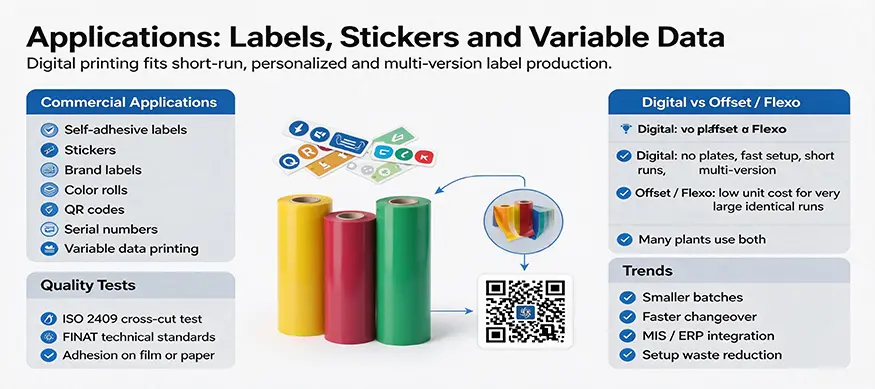
The work that changes a lot, like brand labels in different styles, promotional stickers, and small batches of color rolls, can be printed without plates. Different kinds of data, like serial numbers and QR codes, are often printed with digital tools. Shanghai Honghua makes software for variable data printing, so please make sure that it works with your project. The quality testing should match how it will be used. A cross-cut test called ISO 2409 checks how well a coating or ink film sticks to a surface. The FINAT Technical Handbook has a list of test methods for label materials that stick to themselves. I think you should ask any supplier to show you how well their product sticks to the film or paper you want to use.
Digital Versus Offset and Flexo
Because it doesn't need plates and changes jobs through software, digital is faster to set up, cheaper in the short term, and more customizable. Offset and flexographic presses can still compete when a shop makes a lot of the same design. This is because the cost of the plates is spread out over many labels. For short, urgent, or multi-version orders, many converters work with both digital and analog. For long standard runs, they use analog. Before you decide, I think you should sort your jobs by run time. If most of your orders are small, a plate-free press is a good choice.
Trends Shaping Digital Label Production
Printers are moving toward smaller batches and faster changeovers because of the need for customization, e-commerce packaging, and shorter product lifecycles. Workflow software now takes care of preflight, arranging jobs, and inspections, and sellers are expecting more and more connections to MIS or ERP systems. People are also interested in sustainability. Instead of making broad claims, I think it would be better to measure it by setup waste, inventory decrease, and energy use. This way, procurement teams can get numbers that they can use to compare providers. Shanghai Honghua makes software for variable data printing, coding control, and print defect inspection. This means that our machines can work with workflows that are driven by software.
Operating Cost, Maintenance, and Total Cost of Ownership
What Goes Into Total Cost?
The price you pay for a High-speed Digital Printing Machine only covers part of the cost. The total cost of ownership includes things like paper, ink, electricity, labor, repairs, software, training, shipping, and set-up. Plate-free printing gets rid of the need to make plates and expose them, which lowers the cost of doing short work with multiple versions. To help you plan, keep in mind that our machine needs 0.6–0.8 MPa of industrial air and runs at 20 kW on AC 380V. We can change the power to 110V, 220V, or 380V to meet the needs of your area grid. Ask each supplier how much their consumables cost and how much they think it will cost per meter based on the size of your artwork. Then, use this information to compare quotes.
Maintenance Planning
Make sure to take care of your printheads, ink circuits, curing units, and cleaning on a regular basis. The holiday mode, ink temperature control, and foreign object detection are all meant to keep the printheads and ink system safe between jobs. However, operators should still check the system regularly. Note when the machine is cleaned and when consumables are changed. This way, small changes will be noticed before they become problems. The guarantee from Shanghai Honghua lasts for 12 months, and the company offers technical support for life, quick response times after the sale, online technical help, spare parts, and maintenance support. Get these terms written down from any provider.
Service Life and Long-Term Value
Our press is guaranteed to last 20 years, and we offer service for life after the sale. Stable mechanics are important for a long service life, and the heat-treated base plate and precision-machined printing unit help reach that goal. Over 20 years, the machine's value depends less on how much it cost to buy and more on how often it works, how easy it is to get spare parts, and how much technical help it gets. We've been making things for 20 years and have factories in South China, East China, and Southeast Asia to keep our capacity fixed. Line by line, compare these words to any other quote.
How to Choose a Machine and a Supplier?
Start With Your Job Mix
You should write down your monthly and peak volume, normal run lengths, material widths and thicknesses, number of versions per month, turnaround goals, and color standards. When you're done, compare them to the machine's capabilities. Our press can print in CMYK four colors up to 322 mm wide on materials 75 mm to 350 mm wide. Tell the seller early on if your work needs bigger webs or more than four colors. Before you agree to buy something, ask for printed rolls on your own material and check the color, registration, and stickiness.
Supplier Qualifications to Verify
Look for companies that have experience making things, quality systems, the ability to export, customization, and support after the sale. More than 20 certifications, four industrial administrative licenses, and 13 technical patents are owned by Shanghai Honghua. We offer OEM and ODM services, which include setting up hardware, software features, and branding. All of our tools have a PLC control system that meets international standards. We offer free customized solution drawings and don't have a minimum order size, so you can place a sample order for just one unit. Distributors and integrators can ask about ways to brand the products and how to work together in the long term.
Delivery, Installation, and Training
Get the site ready before the machine comes. It's 2 m x 1.5 m x 1.9 m and weighs 1500 kg, so make sure you know how to get to it and how much weight it can hold on the floor. For rolls, you also need power, air from a factory, and room. It takes about 60 days to make something. We ship by boat, air, train, or express with FOB (Shanghai or Ningbo), CIF, or DAP terms. Our warehouses in Southeast Asia make shipping around the world easy. Export packaging uses solid wooden cases that have been fumigated and filled with shock-absorbing foam. Printheads and servo motors travel in their own separate wooden boxes that can't get wet. It takes 1–3 business days to file a domestic customs declaration. Make sure you get a written copy of the training and activation plan. Then, train one main operator, one backup operator, and one support contact.
Conclusion
A High-speed Digital Printing Machine for Commercial Printing replaces plate making with a direct file-to-substrate workflow, which works well for short, personalized, and multiple-version jobs. This article showed that buyers should look at real samples to figure out how fast a machine can print, check for registration, color control, and adhesion, and then compare digital with offset by run length. For label work, a roll-to-roll press with stable mechanics, controlled ink temperature, and printer security can keep your business running smoothly. Consumables, power, maintenance, and support are all part of the total cost of ownership, which is a more accurate reflection than just the purchase price. The evaluation is finished when the supplier is checked for patents, certificates, customization, shipping terms, and service after the sale. These steps help a printer match the right equipment for the jobs it needs to do and protect the investment over the life of the machine.
FAQ
Does the system need printing plates?
It doesn't need to make plates or expose them because it prints directly from digital files like TIFF and PDF.
What materials and widths can it run?
It makes labels that stick on their own, stickers, brand labels, and color rolls. The feed size ranges from 75 to 350 mm wide and from 0.02 to 1 mm thick. The printing width is up to 322 mm.
Is there a minimum order quantity?
No, we don't have a minimum order size for large sales or testing of a single unit.
Can you adjust the voltage for the United States?
Yes. We change the voltage to 110V, 220V, or 380V to meet the needs of the local grid. Before you buy, please let us know how much power your place has.
What support follows delivery?
We offer a guarantee that lasts for 12 months, expert support for life, remote help, spare parts, and upkeep support.
Request a High-speed Digital Printing Machine Quote From Shanghai Honghua
Shanghai Honghua looks forward to hearing about your project. Send your label materials, monthly volume, destination country, and voltage requirements to [email protected] if you are looking for a High-speed Digital Printing Machine supplier. Our team will suggest a setup, set up test samples, and put together a thorough quote with free solution drawings. You can also look at our gear at honghualabeltech.com.
References
1. Handbook of Print Media (Springer), 2001
2. FINAT Technical Handbook, 2019
3. ISO 2409: Paints and Varnishes — Cross-Cut Test, 2020
4. ISO 12647-8: Graphic Technology — Process Control for the Production of Halftone Colour Separations, Proof and Production Prints — Part 8: Validation Print Processes Working Directly from Digital Data, 2021
5. ISO 15076-1: Image Technology Colour Management — Architecture, Profile Format and Data Structure — Part 1: Based on ICC.1:2010, 2010
6. NIP & Digital Fabrication Conference Proceedings (Society for Imaging Science and Technology), 2022: Markdown