How a Digital Label Machine Streamlines Label Production
A Digital Label Machine makes it simple to create labels by printing art from a digital file directly onto label stock. This works as long as you don't use printing plates. That means you don't need plates, exposure, or long changeovers. This means that the plant can quickly change patterns and make small amounts of something without having to make extra tools. Not only does this cut down on trash, but it also speeds up the waiting time for orders that need to be made quickly or have more than one design. People in the U.S. can use this guide to learn how the technology works, when it's better than flexographic printing, what kinds of businesses use it, and what they should look for in a product before they buy it. I'll also tell you about our own plate-free model's specs.
What Is a Digital Label Machine and How Does It Work?
A Plate-Free Printing System
There is a computerised way to print called a Digital Label Machine that doesn't use printing plates and puts artwork right on label material. It can be set up as a Digital Label Printer, a Digital Label Press, or a full line that can print labels, cut them out, cure them, and split them. Toners are best for short to medium runs of clear text. With an inkjet press, you can get things done faster and more consistently. In hybrid systems, digital printing is mixed with shades or coatings from flexography. Our model is a quick Inkjet Label Machine that can print logos, colour rolls, and labels that stick on their own. You don't need new tools to change the design; you just need a new file.
From Artwork to Finished Roll
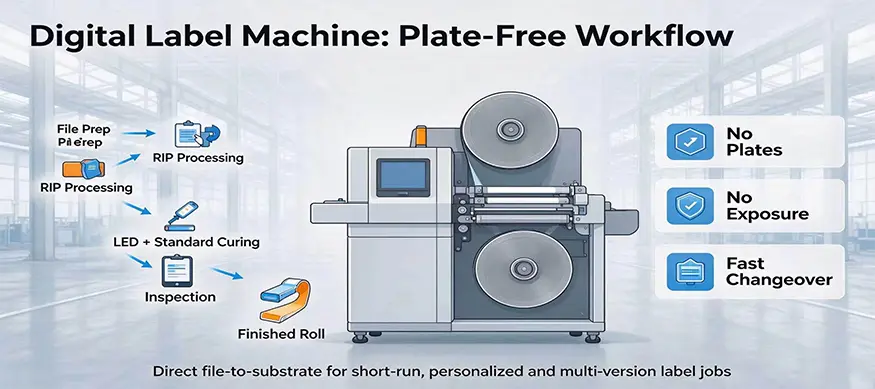
Getting a file ready is the first step in the process. Barcodes, QR codes, and information that changes can all be read by our machine. It can also read TIFF, PDF, and other similar files. The roll is put on by hand, and the printheads put tiny droplets of CMYK four-color ink on the paper. Then, to dry the ink, we use our LED + standard dual-curing method. Before each roll leaves the queue, the team checks its colour, registration, adhesive, and barcode reading. Plants can use the ASTM D3359 tape test to see how well ink sticks to surfaces, and ISO 12647-8 gives rules for process control for digital print validation. The FINAT Technical Handbook also has ways to test labels that stick to themselves. With these steps, you can quickly print a sticker that you can use.
Key Features of Our Plate-Free Model
These are the most important parts of our model that will be used in the workshop.
- Sizes and types of materials: The machine can handle sheets that are 75 mm to 350 mm wide and 0.02 mm to 1 mm thick. It can print on things that are as wide as 322 mm. Rolls for unwinding and rewinding can be up to 800 mm across. Take a look at these limits against the rolls you've already made before you ask for a study test.
- With its built-in printing unit, you can consistently place things 0.005 mm apart. Any colour can be used for the second print. The machine can print on both the front and back. A base plate that has been cut to a high level of accuracy and heated several times is made not to bend, which helps keep the position of the prints fixed. Patented joining technology lets you print without any obvious joins.
- Because of its unique design, an ink circuit goes into holiday mode as soon as the power is turned off, which is less than one minute. Setting the right temperature for the ink starts with the main ink cartridges. Printing stays steady when the design has more than one stage of negative pressure. Unique slit LED technology that doesn't let any light leak through helps keep the printheads clear, and automatic recognition of foreign items keeps them safe.
The goal of these features is to fix common production problems like roll-size mismatch, registration error, and printhead downtime.
How a Digital Label Machine Cuts Setup Time, Waste, and Lead Time?
Skipping Plate Making and Exposure
When a Digital Label Machine prints regular labels, the first thing it does is use plates. Someone has to get them ready, mount them, and fix the registration before the first good label shows up. The work costs money and takes time away from the plan. That's why our plate-free machine is better than the old way of making plates: it doesn't open or show the plates. In other words, a job doesn't need as much work before it goes from the file to the press. This cuts down on work time and costs, and it also makes sure that very little material is lost during setup. It will save plants a lot of money because they won't have to pay for each job all at once. Users are less likely to make mistakes when they don't have to do as much actual work.
Short Runs, Many Designs, and Rush Orders
Plate-based lines get a lot of work when they need to make few copies or change the art a lot. A Digital Label Machine can easily handle new designs since each one is just a new file. It works well for printing quickly, in small amounts, with many designs, or in several batches. It gets easier to price and plan for things that are only available during certain times of the year, regional SKUs, limited editions, and marketing campaigns. With digital processes, businesses can make labels closer to when the customer needs them, which means that less stock is kept on hand. That way, you're less likely to print too many labels that you never use. One can test a new item with a small amount before a dealer or private-label brand buys more.
Variable Data Printing and Print Accuracy
Plate-based lines get a lot of work when they need to make few copies or change the art a lot. A Digital Label Machine can easily handle new designs since each one is just a new file. It works well for printing quickly, in small amounts, with many designs, or in several batches. It gets easier to price and plan for things that are only available during certain times of the year, regional SKUs, limited editions, and marketing campaigns. With digital processes, businesses can make labels closer to when the customer needs them, which means that less stock is kept on hand. That way, you're less likely to print too many labels that you never use. One can test a new item with a small amount before a dealer or private-label brand buys more.
Digital Label Machine vs. Flexographic Printing: Where Each Fits
Where Digital Printing Wins?
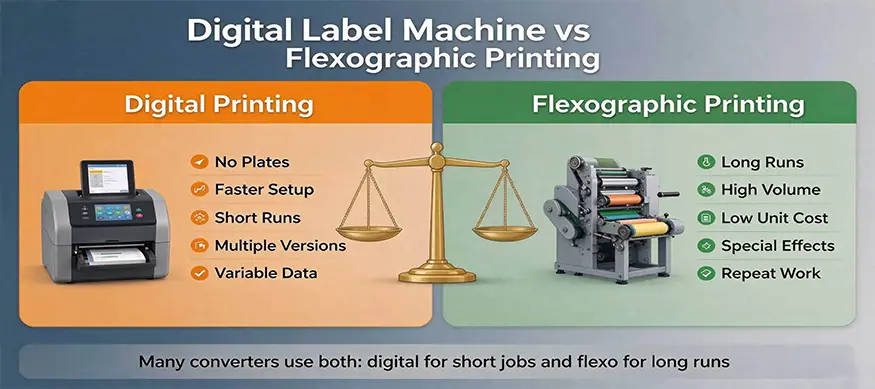
You don't have to pay for plates when you use a digital method, and you can change the art more often and for shorter runs. Another thing they can do that a plate-based press can't is work with data that changes. When a plant makes a lot of different SKUs in small batches, it can cost more to set up and buy plates than it does to buy ink and film. Both are gone when you print digitally. The production manager can also plan ahead for quick orders without having to wait for new plates. This keeps customers who need things quickly safe. You don't have to store as much when you print less, so your warehouse has more room.
Where Flexographic Printing Still Makes Sense?
I don't think digital printing is always the best choice. Many standard labels can still be made for less money with a flexographic press because the costs of the plates and setup are spread out over a large order. A combination press or flexography may also be a good choice if the finish is complicated, there are special decorations, or the repeat runs are very long. People don't buy the wrong thing when they can compare things fairly. Flexography is what some processors use for long runs, while digital is what they use for everything else. We want to match each order with the process that can sell the most labels for the least amount of money. Not the process that has the cheapest machine. You should think about speed, waste, substrate range, labour, and order frequency before making a choice.
Industry Applications for Digital Label Printing
There are many places where digital label printing is useful. Food, drink, and product brands use it to make unique packaging, versions for different areas, and SKU changes that happen all the time. In the U.S., labels on chemicals and things used at work usually need to follow OSHA's Hazard Communication Standard. This standard needs a warning word, a product name, danger statements, pictograms, and statements about how to be safe. The Drug Supply Chain Security Act says that some prescription drug boxes need to have labels that say what the drug is. This includes putting drugs away. People who buy these labels must make sure that the material, ink, and compliance are correct. A Digital Label Machine can print the variable data that these rules need. With short runs, you can also make packages that are sold online or under your own brand stand out.
Digital Label Machine Buying Guide for U.S. B2B Buyers
Build Your Production Profile
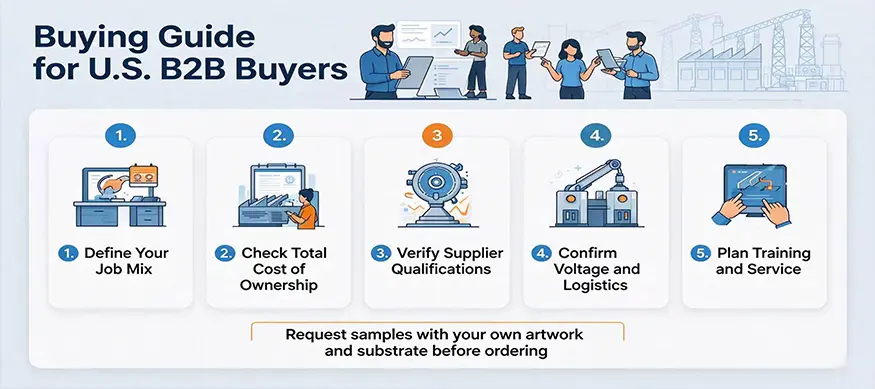
For a Digital Label Machine, get your own numbers to begin with. For each SKU, write down the number of shifts, the amount, the average run length, and the shipping speed that your customers expect. Then you need to make sure that those numbers are within the machine's limits, such as the feed width, print width, material thickness, and roll size. Our printer can print up to 322 mm wide on its narrow web. It works well for making labels and stickers, but not for printing on a large area. Aside from artwork files, procurement managers should also find out what materials are being used and what finishing is needed, such as die-cutting or slicing. This helps them come up with the best design. It will be easier to talk to suppliers if you write them all on one page.
Compare Specs and Total Cost of Ownership
Price isn't the only thing that matters. Things like materials, labour, repairs, energy, waste, software, training, setup, shipping, customs, and downtime are all part of the total cost of ownership. To work, our machine needs 20 kW of power and industrial air at 0.6 to 0.8 MPa, so make sure that your model has those specs. Compare the costs of outsourcing, the time wasted on setup, labour, the time saved on delivery, and the extra money made from short-term work. If you want to buy used equipment, make sure you check the printer's condition, make sure it works with your software, see if there are extra parts available, and make sure the warranty covers what you buy. Hidden costs might wipe out the savings if you don't. Ask each seller for the same things so that the quotes are all the same.
Evaluate the Supplier, Service, and Logistics
They should tell you more about the item than just the price. Ask for clear instructions and ways to make the work your own, as well as test samples made with your real art and materials. Honghua has been making things for 20 years and has more than 20 certifications and 13 technical patents. You can choose from 110V, 220V, or 380V power, and we offer free customised solution plans. For both OEM and ODM projects, we also have PLC control systems that meet foreign standards. To make something, it takes about 60 days. We can try single units or take big orders with no minimum order size. We ship by sea, air, rail, or express with FOB (Shanghai/Ningbo), CIF, or DAP terms. There is a 12-month warranty on all Digital Label Machines, and you can get free technical support for life. Stores in Southeast Asia handle shipments to other countries.
Implementation: From Installation to Stable Production
Audit Your Current Label Production
Figure out where you are now before you add anything. Keep track of how many orders you have, how long each run is, how long it takes to set up, how much you waste, how many mistakes you make, how much you spend on outsourcing, and how many deliveries you make on time. That way you can tell if a plate-free system is worth the money, and it's also simple to compare things after launch. After that, print a test copy using real artwork, colours that are tricky to work with, barcodes, and the backing materials you want to buy. Please bring your toughest label so that we can test some before you order a lot of them. Check the quality, colour match, adhesion, and readability of the barcodes on the finished label. Make sure that everyone on the technical and production teams agrees on the goals before you send out a buy order.
Plan Space, Power, and Utilities
The size of our machine is 2 m x 1.5 m x 1.9 m, and it weighs 1,500 kg. Make sure the floor is strong enough, the door is wide enough, and you have the right tools to move it before you deliver it. It takes 20 kW of running power, an AC 380V power source, and air pressure between 0.6 and 0.8 MPa. Let us know right away if your plant has a different grid. We can change the voltage to 110V, 220V, or 380V. Each machine is shipped in a solid wooden case that has been fumigated and lined with foam that absorbs shock. Fine core parts like servo motors and inkjet printheads are sent in their own wooden boxes that keep water out. We also go over the papers that need to be cleared by customs when we get there. The machine is meant to last twenty years.
Train Operators and Track Results
To add media, change colours, clean, make sure the drying is done, or fix a problem, write down simple steps. Each shift should learn the same steps. From the beginning, keep an eye on the uptime, the amount of output that can be sold, the setup time, waste, duplicates, cost per label, and on-time delivery. You should check these numbers against your norm every month. Remote technical support, extra parts, repair, and help are all things that our team can do for you. For life, you can also get tech help, even if your needs change. When you get help right away after the sale, small problems don't turn into long stops. If you can see it, a new Digital Label Machine can be a clear win for your business. It tells you when to add shifts too.
Conclusion
Plates are not used in a Digital Label Machine. Instead, digital files are used. Short-notice, low-volume, and mixed-design orders take less time to set up, spend, and wait. The article talked about how to print, cure, and inspect a file to make a finished roll. It also talked about how variable data and positioning accuracy of 0.005 mm can be used to make labels that are always the same. It weighed the pros and cons of digital printing and flexographic printing and came to the conclusion that flexographic printing is still the best way to go for long runs. Also, it showed that digital printing can be used for labels on medicines, chemicals, food, and cosmetics as long as the tests for strength and compliance are passed. People get the best picture when they look at the total cost of ownership, try samples, check bills, and read service terms. The plants that can use this technology the most are the ones that have a lot of SKUs and short runs.
FAQ
What is a Digital Label Machine used for?
That isn't how it prints. Instead, labels, stickers, logos, and color-printed rolls that stick to themselves are made directly from digital files. It works well for quick sales, small orders, different patterns, and many runs.
How does it differ from a flexographic press?
It costs more and takes longer to set up a flexographic press because each design needs its own plate. When you make changes to the artwork on a Digital Label Machine, you don't have to change the plates. Things that need to be done over and over for a long time can still be done for less money with flexography.
What materials can your model print on?
Paper that is 0.02 mm to 1 mm thick and 75 mm to 350 mm wide can be fed through it. It can print up to 322 mm wide in CMYK four-color. Please send us some of your work so that we can check it out.
Can you customize the machine for my plant's power supply?
Yes. The power is changed to 110V, 220V, or 380V, and PLC control systems that meet global standards are put in. Tell us about your power, and our engineers will make sure that everything is set up correctly.
What support do you provide after delivery?
You can get a one-year promise, professional help for life, online help, and extra parts from us.
Call to Action: Plan Your Digital Label Machine Upgrade with Shanghai Honghua
Shanghai Honghua is ready to review your label samples and recommend the right Digital Label Machine for your plant. As an experienced supplier, we offer single-unit orders, customized voltage, a 12-month warranty, and lifetime technical support. Send your substrates, run lengths, and artwork to [email protected], or visit honghualabeltech.com for details. Request a sample test and quotation today.
References
1. OSHA, Hazard Communication Standard (29 CFR 1910.1200), 2012
2. U.S. Food and Drug Administration, Drug Supply Chain Security Act (DSCSA), 2013
3. GS1, GS1 General Specifications, 2024
4. ISO, ISO 12647-8 Graphic Technology: Process Control for the Production of Halftone Colour Separations, Proofs and Prints, Part 8: Validation Print Processes Working Directly from Digital Data, 2021
5. ASTM International, ASTM D3359 Standard Test Methods for Measuring Adhesion by Tape Test, 2017
6. FINAT, FINAT Technical Handbook, 2019