How Digital Roll Label Printers Improve Label Production Efficiency
A Digital Roll Label Printer improves label production efficiency by printing artwork straight from a digital file onto roll-fed media, so your team no longer makes plates, exposes film, or builds a long press setup for every job. Changeovers happen in software, setup waste drops, and short runs, multiple SKUs, and urgent orders move through the line faster. Variable data, such as serial numbers and QR codes, prints in the same pass. Below, I explain where traditional workflows lose time, how digital printing recovers it, which specifications matter, and how to judge cost and suppliers.
Label converters, packaging suppliers, and manufacturers face the same pressure: more SKUs, smaller orders, tighter deadlines, and stricter compliance rules. Smithers market reports project continued growth in digital printing, including labels. I focus here on practical decisions that improve capacity, responsiveness, profit, and on-time delivery.
Where Traditional Label Production Loses Time and Money?
Plate Making, Setup, and Make-Ready Delays
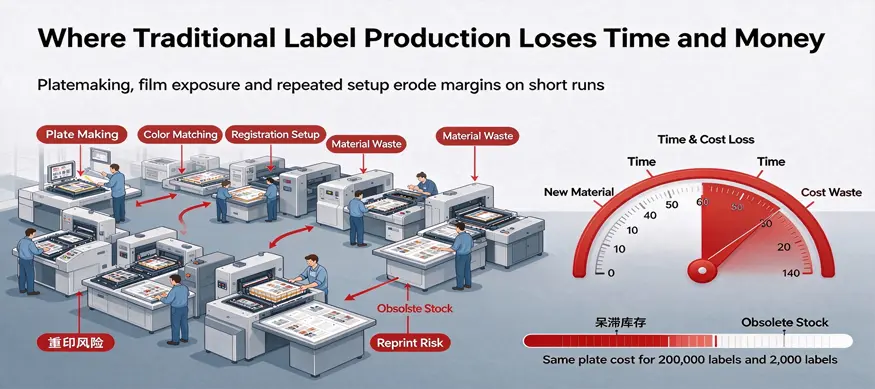
When you make labels the old-fashioned way with plates, it takes a few steps before you get to the first good label. It takes a team of people to prepare the plates, place them, match the colors, set the registration, and run the material until it passes. Each step takes work and time to press. When a translator works with a lot of SKUs or when artwork changes often, this getting-ready step is done over and over again. It takes longer for the press to wait than to print. It takes time to make up too. Films and specialty papers aren't cheap, and the labels that are printed during the adjustment process are usually thrown away. It costs a lot of time and money to plan for making a few thousand labels.
Why Short Runs Hurt Margins?
The fixed costs of getting something ready don't go down when an order comes in. A plate set for 200,000 labels costs the same as one for 2,000 labels, so each short-run label gets a bigger piece of the pie. Customers are placing smaller and smaller orders, which means that there are more shift changes. It affects more than just the press. If you print extra labels to cover setup costs when the design changes, you end up with stock that you can't use anymore. Also, if you fix the artwork too late, you might have to reprint and miss the ship date. It's also harder to plan work hours because each job needs skilled workers to set up instead of steadily making things.
Baseline Metrics to Record Before You Invest
Before you look at other tools, I think you should write down five numbers from the way things are now. These are the turnover time, the waste percentage, the amount of work that gets done in a shift, the cost per label, and the percentage of on-time deliveries. Put them into groups based on the length of the job after a few weeks. Short runs and long runs work in different ways. Waste includes labels that were turned down or printed again, and the cost of each label includes the time it took to print. You can make a fair comparison later if you start with these points. They let you check what a seller said against what you got. You might buy something that solves a problem you don't have if you don't have them.
How a Digital Roll Label Printer Works and Where the Gains Come From?
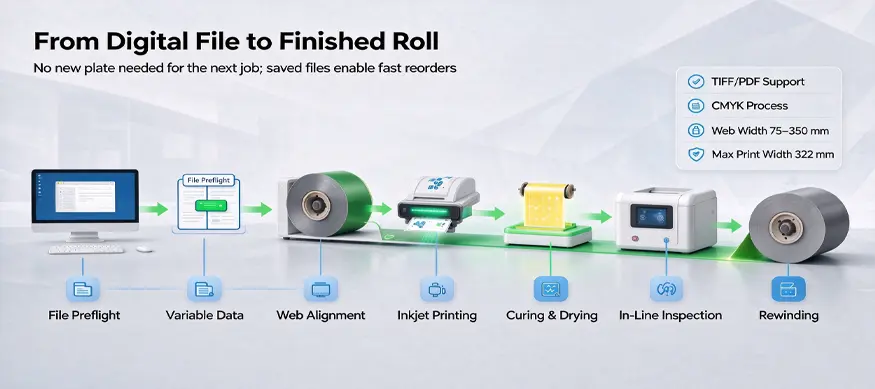
From Digital File to Finished Roll
It prints digital art directly onto label paper that doesn't need to be cut. This type of printer is called a Digital Roll Label Printer. Preflighting the art and getting the variable data ready are the first steps in the process. The web is then lined up and put into a computer picture. It takes a while for the ink to dry, and workers check the work several times before it is finished or rewound. The plan is saved in a file, so a new job doesn't need a new plate. We can print four-color CMYK files from TIFF or PDF files on our Shanghai Honghua machine. It can work with things that are 75 mm to 350 mm wide and remove and rewind rolls that are up to 800 mm across.
Workflow Automation That Saves Operator Time
How fast the hardware of a Digital Roll Label Printer works is important, but how often the press runs is fixed by the software. Employees can plan their work ahead of time with job queues and repeat-job settings that remember the artwork and parameters they used for previous jobs. Tools that work with variable data can take a source of data and turn it into barcodes, serial numbers, and QR codes. Before they are shipped, the codes are checked to make sure they can be read. The production reports show any delays or waste, and when ERP or MIS is linked, there is no need to enter orders by hand anymore. A technician can look at a problem even if they are not there. Each provider should be asked to list the features that come with their package and the ones that need extra modules. Our tools all have PLC control systems that are up to par with foreign standards.
The Main Efficiency Benefits
There are four places where you can see improvements in efficiency. It takes less time to get orders for holidays, sales, and urgent needs because changes are made without having to do plate and color work. When you have less setup waste, you can buy films and specialty substrates for less money. A reorder fits the last run, and the number of repeats goes down. This is because saved files make it easy to do again. We no longer need a different process for jobs where the data changes. All of these changes make it easier to keep track of products, restock quickly, and address late order changes from customers in other countries.
Specifications, Technology Comparison, and Application Fit
Reading Specifications Beyond the Headline Numbers
Start with the numbers that can make or break your day. Our machine can print on things that are up to 322 mm wide and 1 mm thick. More than that, it can print in any color on both the front and back. The repeat positioning accuracy of the built-in printer is 0.005 mm, and there are two curing systems: one that uses LED curing and the other that uses traditional curing. Full-circuit ink temperature control, slit LED technology with zero light leakage to keep the printhead from getting clogged, and automatic foreign object detection with printhead protection are some of the design features that protect uptime. The ink circuit has a holiday mode that starts up within one minute of the power going off. Plan for 20 kW, AC 380V, 0.6–0.8 MPa industrial air, and a size of 2 m x 1.5 m x 1.9 m for 1,500 kg. You shouldn't just believe the scores; you should also test your own work.
Digital, Flexo, and Hybrid Production
Since digital printing doesn't need plates or long setup times, it's better for short runs, data that changes often, fast delivery, and variable data. When you order a lot of labels over a long period of time, flexographic presses may be cheaper because the costs of the plates are spread out over many labels. Some formats work best with sheet-fed systems, while roll-fed systems can handle continuous output and finishing on their own. If you want to compare inkjet and toner systems, you should use your own materials. This is because they have different ink chemistry, substrate range, maintenance needs, and overall costs. A lot of the time, converters use both digital and rubber stamp printing. Flexo is used for large orders that are made over and over again, while digital is used for customization and small runs. As a first step, I believe you should find out how much a normal job costs both ways.
Matching the Machine to Your Application
The tools we choose depend on the job. Labels for packages and things need to be able to change colors quickly and correctly. A lot of the time, food and drink labels need to be waterproof and have data that can be tracked. Short runs are best for craft brands with a lot of SKUs. Cosmetics tags might need clear covers and small print. Medicine labels need to be kept track of and have barcodes that can be read. The Drug Supply Chain Security Act in the US says that sequencing must be done in a certain way. Labels for factory and logistics use need to be tough and have barcodes that can be read. In the GS1 General Specifications, it is written down how barcodes can be used in supply chains. Before you send your design to us, make sure it doesn't need heavy metal or white ink.
Cost, Procurement, and Implementation
Calculating Total Cost and Return on Investment
The machine's price alone doesn't tell the whole story. You should think about how much it will cost you to own a Digital Roll Label Printer, including ink, paper, trash, labor, power, repairs, software, setup, training, and any loans. There should be more than just consumables in the price per label. Setup, finishing, inspection, rejected work, reprints, old stock, and rush delivery should also be on the list. Then, find the return in three different situations: when it's small, when it's expected to grow, and when it doesn't. You can use monthly sales, higher margins, lower inventory, faster delivery, and extra money from personalized or short-run services as inputs. Don't lie about the case for conservatism. After careful thought, people should have more faith in a project that pays off.
A Procurement Checklist for Global Buyers
First, write down what you need: the rough number of items, the length of the job, the label width, the roll specifications, the substrates, the color needs, and whether the production is for use inside or outside the company. After that, you should look at providers' manufacturing knowledge, quality systems, installation, training, spare parts, and references from companies that work in the same field. Shanghai Honghua has been making things for 20 years and has bases in South China, East China, and Southeast Asia. It has 13 technology patents and more than 20 licenses. There is a warranty for 12 months and free expert help for life. The lead time is about 60 days. This can be changed to 110V, 220V, or 380V, and it can be shipped by sea, air, train, or express with FOB, CIF, or DAP terms. You can also order just one unit from us. Get a written price that includes the modules, speeds that have been tested, outputs that will be used up, and the costs of setting up the system. For a test run, you should also use your own art.
Implementing the Workflow After Installation
Getting the machine is only half the work. Always check your color profiles, barcode rules, artwork files, and variable-data templates to make sure they are all the same. Do this before every job. To make sure that output is the same from job to job, only keep media profiles that have been approved and store rolls in controlled areas. To cut down on changes, orders should be put together by substrate or finish. Maintenance should be planned ahead of time for printheads, rollers, sensors, web paths, and curing systems. A holiday mode on our machine lets us shut it down when we want to. Keep an eye on uptime, loss, first-pass yield, stoppages, and repeats every week. Next, look at the patterns to see what you should change.
Proving the Results and Planning Ahead
Verifying the Efficiency Improvements
To be sure the printer is useful, use the standard you set to see how things were before and after. It's important to keep an eye on things like setup time, wasted materials, lead time, labor hours, jobs per shift, rejection rate, and on-time delivery. Some financial measures that should be added are the cost per label, the use of the machine, the reduction of inventory, and the income from short runs that make money. Check the numbers every month or three months. When there is a gap, show your source the data and talk about what needs to be done to fix it. Giving specific numbers instead of general opinions shortens the talk and makes it more useful.
Quality Control Checks That Protect Your Gains
Making sure the work is good will keep the time you save safe. A lot of buyers check the color with a spectrophotometer and aim for a Delta E level of less than 2.0 between runs. The cross-hatch tape test (ASTM D3359) checks how well ink sticks to man-made surfaces. While ISO/IEC 15416 rates one-dimensional symbols, ISO/IEC 15415 rates two-dimensional symbols. Most of the time, buyers in logistics want Grade A or B. A Sutherland rub test can be used to simulate flow friction, and optical sensors that check for registration can be used to catch drift. We have two patents for tools that check for online vision flaws and print flaws.
Future Trends in Digital Roll Label Production
A lot of things will happen over the next few years that will shape them. Schedules that are automatically made, AI that finds bugs, predictive maintenance, cloud tracking, and online help are all meant to make things simpler and cut down on unplanned downtime. Variable data printing is more useful because people want unique labels, QR codes, and the ability to keep track of things. When people want to be more environmentally friendly, they might be more likely to use light, recyclable materials and methods that make less waste. This means that new and old systems are likely to keep working together. Flexo will handle a lot of repeat orders, while digital will handle customization and short runs.
Conclusion
Label making is slowed down by the time it takes for plates, setups, and color matching on the press. This is very important for small orders and orders with more than one SKU. With a Digital Roll Label Printer, you don't have to make plates or make changes to software. You also make less waste when setting up. It's easier to do the same thing over and over again when you have stored files and data that you can change. You can only learn about things like web width, roll thickness, curing method, and placement accuracy by testing them on your own materials. It is best to use digital printing for small runs and pressing orders. Flexo printing is still the best for large jobs and jobs that need to be done more than once. A hybrid model works best most of the time. The overall cost, help from the provider, starting points, quality checks, and regular reviews will show if the efficiency gains are real and will last.
FAQ
What is digital roll label printing?
It doesn't use plates, so it just copies digital art onto label paper that is fed through a roll. This means that you don't need any new tools to change a design; you just need software. This type of system is often referred to as a Digital Roll Label Printer.
Does it reduce setup time and waste?
Yes. Because there are no plates, exposure, or color-matching rounds, it takes less time to set up and leaves fewer labels behind. It will depend on the jobs you print, though.
Is it suitable for short runs and small businesses?
Yes. Short runs, different SKUs, and pushing special orders work best with it. For sample sales of one unit, Shanghai Honghua does not have a minimum order quantity.
What should I check about speed and resolution?
Find out how fast your items can be made and how much ink they hold. Print samples, small text, and barcodes can all tell you how high the resolution is.
How do I compare it with flexo and judge a supplier?
Get an estimate for a normal job that goes both ways, and then ask to see samples on the materials you provide. Before you decide, you should look at the total cost of ownership, the warranty, the spare parts, and the customer service.
Request a Digital Roll Label Printer Quote from Shanghai Honghua
Digital Roll Label Printers have been made by Shanghai Honghua for 20 years. They offer OEM and ODM choices and free technical support for life. Our team will make you a unique price and a sample test plan as soon as you email [email protected] with your label size, monthly quantity, substrates, and artwork. At honghualabeltech.com, you can learn more about our services and tools.
References
1. Smithers, The Future of Digital Printing to 2029, 2024.
2. ASTM International, ASTM D3359 Standard Test Methods for Rating Adhesion by Tape Test, 2023.
3. ISO/IEC, ISO/IEC 15416 Bar Code Print Quality Test Specification – Linear Symbols, 2016.
4. ISO/IEC, ISO/IEC 15415 Bar Code Symbol Print Quality Test Specification – Two-Dimensional Symbols, 2011.
5. GS1, GS1 General Specifications, 2024.
6. U.S. Food and Drug Administration, Drug Supply Chain Security Act, 2013.