What Is a Digital Label Press and How Does It Work?
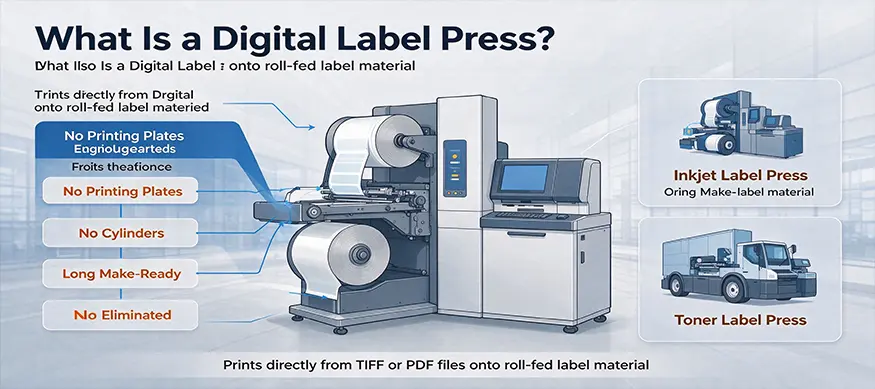
A Digital Label Press is an industrial printing system that prints labels directly from a digital file, so it needs no printing plates, cylinders, or lengthy make-ready. Software prepares the artwork and color data, printheads place ink on a roll of label material, and a curing unit fixes the image before the roll is inspected and finished. Inkjet and toner models both exist, and each suits different run lengths and materials. This guide explains each step, compares digital with flexo, and shows how our plate-free inkjet label press from Shanghai Honghua fits short-run, multi-SKU, and rush orders.
What Is a Digital Label Press?
A Plate-Free Way to Print Labels
Label printing methods like flexo and letterpress need real plates to work. Someone needs to make them, mount them, and line them up. A new design needs a new set. With a Digital Label Press, that step is skipped. It can read a file type like TIFF or PDF and use printheads to put the picture on the paper. To switch styles, you don't have to switch tools; just load a new file. Also, that helps when there are a lot of SKUs, short lots, or tight dates. This is because the plates and wait time can cost more than the order is worth. An office printer or a wide-format machine is not the same as a label press. A label press feeds from a roll, keeps registration, and runs all the time.
Inkjet and Toner: Two Main Types
Most Digital Label Presses use one of two printing methods. There are very small drops of ink that come out of the printheads and onto the web. Electricity is used in toner presses to make an image, which is then pressed onto the item. It's used in a lot of pictures and fake stocks, especially ones that fix with UV or LED light. This is because the image quality stays the same when the labels are printed on paper. If you need to make changes, the length of the run, the range of materials, and the cost of products will all affect which one works best. An inkjet is the type of machine we have. It can print in four colors (CMYK) and has both an LED and a normal way to dry the ink.
Key Specifications of Our Plate-Free Label Press
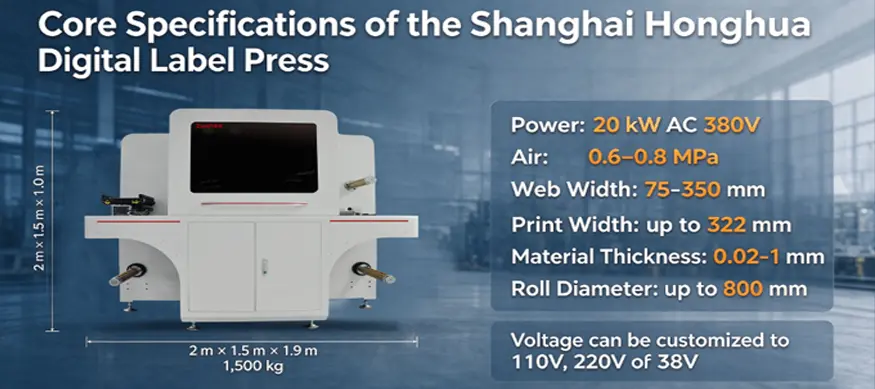
This is how your floor has the Shanghai Honghua machine set up. It's 2 m long, 1.5 m wide, and 1.9 m tall, and it weighs 1,500 kg. It works on 380V AC at 20 kW and needs industrial air at 0.6 to 0.8 MPa. It can work with things that are 0.02 mm to 1 mm thick and 75 mm to 350 mm wide. It can handle prints up to 322 mm wide, and the rolls it can unwind and rewind have a diameter of up to 800 mm. You can put in TIFF and PDF files. What kind of power does your business need? We can change the voltage to 110V, 220V, or 380V.
How Does a Digital Label Press Work?
Step One: Prepress and File Preparation
All jobs start on the computer. A person in charge checks the artwork's resolution, bleed, color profiles, and trapping. They check the data first to see if the order has any serial numbers, QR codes, or barcodes because every label has the same database mistake. The color management is done by the digital front end after the file is changed. It then makes the high-resolution picture that the printheads use. Thanks to calibration and standard color guides, the results stay the same for repeat sales and in more than one place. For jobs where the content changes, we also make variable data printing software and software for controlling the code. When you do careful prepress, you find mistakes early on, so you don't lose any paper.
Step Two: Printing and Curing
After this, with a Digital Label Press, the roll is put in, and the web is pushed through the print unit. The print heads put down controlled CMYK drops, and the sealing system holds them in place. The repeat placement accuracy of our built-in printing unit is 0.005 mm, and the machine can print in any color on both the front and back of the paper. LED and regular methods are both used for curing. The slit LED design keeps the printhead clear by not letting any light out. One method keeps the main ink refills at the right temperature all year long with a full-circuit ink temperature control system. The workers keep an eye on registration, web tension, printhead state, and curing while the run is going on.
Step Three: Inspection and Finishing
Before the web is used to make labels, it is checked for flaws and then cut into shape. A stray object is less likely to damage printheads because our machine finds them right away and protects them from damage. Die-cutting, slitting, laminating, varnishing, foiling, and rewinding are some of the finishing steps that can be used. Know how the press works with the rest of your tools. Different transforming lines are fed by different systems, and straight finishing lines are connected to other systems. Among its patents are ones for label die-cutting, high-speed label moving, and window trash removal. This helps us picture how printing and finishing really work together.
What Are the Advantages of a Digital Label Press?
Short Runs, Many Versions, and Faster Delivery
For label companies that get a lot of different kinds of orders, these are the key pros:
- No plate cost or wait: For every new design, plate-based printing needs to make plates or show plates, but plate-free printing doesn't have to do either. It costs less to set up, and the tools for a few hundred labels don't have to cost more than the order itself. That changes the numbers for small clients.
- Many versions on one press: Since each plan is a file, switching between versions is mostly a software job and not a mechanical one. Instead of keeping a lot of labels that might not be useful after a while, brands can print localized text, seasonal artwork, and special versions in small groups. Not only does this save money on storage fees, but it also gets the job done quickly.
- Fast response to rush work: It can go right to press if the file is good. For customers who need their orders quickly or precisely, that makes just-in-time production possible. Plus, they don't have to wait for plates as they do with standard printing before the first label shows up. This makes it easier for sales teams to do what they say they will do.
These pros make up for plate-based printing's high cost, long wait time, and lack of freedom when doing small amounts of work in a lot of different styles.
Digital Label Press vs. Conventional Printing
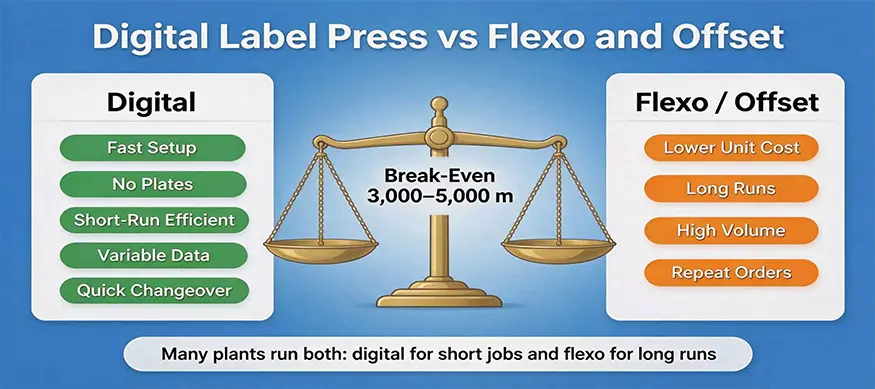
There are different technologies that can be used depending on the cost, the artwork, the material, the finishing, and the length of the run. Digital Label Presses are easier to set up, need smaller orders, and print data that can be changed more quickly. A flexo or offset press can offer lower unit costs for long repeat runs once the tools and set-up are done. Most of the time, the break-even point is thought to be between 3,000 and 5,000 linear meters. However, this can change based on how much the ink costs, how fast the press works, and how the label is designed. Test it with information from your own job. Also, remember that a CMYK four-color press needs color management to handle brand colors, so make sure you get a PDF of the colors first.
A Hybrid Strategy Often Works Best
Many people who switch to digital keep their flexo line and add a digital press next to it. The digital machine can do jobs that are short, clear, and quick. Because it costs the least per unit, the traditional press only works on steady, large orders. Both sides can make money with this split, and flexo crews don't have to change over small orders all the time. Distributors and system designers should both tell customers the same thing: don't fix the speed of the press to a single number. Instead, match the press to the mix of the order. Most of the time, you can find the right mix by counting how many jobs are shorter or longer than the length needed to break even.
How to Choose the Best Digital Label Press for Your Business?
Substrate Compatibility and Print Quality
Start with the things to consider for a Digital Label Press. How well something sticks, changes color, heals, and lasts is based on its layer, absorption, thickness, surface energy, and how it's put together. Not all UV inkjet printers can use plain paper. Some need a base or corona treatment to make the surface more energetic so the ink sticks better. The machine we have can make labels, logos, stickers, and color-printed rolls that stick to each other. Find out what products are okay to use and test your own stock before you buy. Then, compare the results to how you plan to use it, like for storage, poisons, water, or normal wear and tear. AsTM D3359 cross-hatch tape is used to check if something sticks, and ISO/IEC 15416 is used to check if barcodes are good.
Operating Cost, Speed, and ROI
Price alone doesn't tell the whole story. Costs of ink, substrate, labor, energy, repairs, software, service, inspection, and finishing are all added up to get the total cost of ownership. Our machine has 20 kW of power, so make yours stronger. You can also get the speed wrong. You should instead check the effective output, which is the number of labels that can be sold after setup, changeovers, sealing, inspection, and conversion. To find the return on investment (ROI), you should look at the number of orders per month, the average size of an order, the number of hours the press was used, the profit margin, and any extra costs for things like engraving or fast delivery. Put together three cases: the growth case, the expected case, and the conservative case. If you want to be safe, trust the return number.
Supplier Support, Customization, and Delivery
Uptime depends on both the machine and the supplier. Shanghai Honghua has factories in South China, East China, and Southeast Asia. They have been making things for 20 years. We ship by sea, air, rail, or express, and it takes about 60 days to make something. There is a one-year warranty, professional support for life, online help, and spare parts as part of the support. The PLCs that run our tools are up to world standards. We give away free solution plans, let you order as few as one unit, and offer OEM and ODM choices for hardware, software, and branding.
Common Challenges and Future Trends in Digital Label Press Technology
Mistakes That Hurt Return on Investment
People usually only look at a press's price and speed rate when deciding what to buy. After a while, other issues appear, such as substrates that aren't allowed and cause issues with sticking or curing, a conversion speed that isn't fast enough, and unexpected costs for supplies. It is important to give the same amount of attention to both training operators and maintenance. Our one-of-a-kind ink circuit design has a holiday mode that turns on as soon as the power goes out. Plants that aren't making anything will benefit from this mode. Do a test run with normal tasks and look over the whole line, which includes quality control, delivery, prepress, printing, inspection, finishing, and quality assurance. This will help you avoid any mistakes. The press is a link in that chain.
Quality Control Checks That Protect Output
Customers can measure quality control. Spectrophotometers that are built in can keep an eye on Delta E color drift as the run goes on. The ASTM D3359 cross-hatch test checks how well ink sticks to films that don't have any holes in them. Both 1D and 2D barcodes can be read correctly when the scans meet the requirements of ISO/IEC 15416. Soap wipes with MEK or alcohol and Sutherland rub tests are used to see how long the ink layer lasts. Vision tools can check to see if the die-cuts are accurate and in the right place. ISO 12647-8 and other color rules help keep the gap between shades small. Talk to your service provider about what parts of the press supports need to be checked with different tools.
Where Digital Label Press Technology Is Heading?
The market for digital labels is likely to keep growing as long as companies want shorter supply chains, smaller inventories, and packaging that is more relevant to each country. You can print changeable data on serialization, QR codes, and track-and-trace apps, and GS1 standards tell us how to set up a lot of barcodes. Automation is making it easier to set up, calibrate, find problems, and do remote diagnostics. This means that operators don't need to be as skilled. Some people think that less plate trash and make-ready materials are better for the environment. However, each project still needs to look at the ink chemistry, energy use, and recycling options. Digital tools will still be used for freedom, and classic presses will still be used for numbers for a lot of things.
Conclusion
If you want to print labels from digital files, a Digital Label Press gets rid of the need for plates, cylinders, and a lot of your prep work. To handle colors and do prepress work, then print, cure, check, and finish. The process never ends. It works best for short runs, a lot of different forms, data that changes, and turning things around quickly. On the other hand, flexo and offset work better for long runs, which is why hybrid production is so common. It's not enough to just look at price or rated speed when choosing a sound card. You should also look at substrate testing, effective speed, total cost of ownership, and supplier support. Quality checks, such as Delta E monitoring, adhesion testing, and barcode grading, can be used to measure results. This list of details shows how these ideas work in the real world.
FAQ
How is a digital label press different from a flexo press?
It takes time and money to set up a flexo press because it needs plates for each design. It's faster and takes up less room to print from a file on a Digital Label Press. This is great for short runs and changing data. When you buy a lot of labels, flexo usually costs less per label.
When does a digital label press make financial sense?
It works well for jobs that are short (less than 5,000 square meters), have a lot of SKUs, or need to be finished quickly. Test it with your own job data to find out the exact break-even point for a Digital Label Press. It depends on how fast you print, how much ink costs, and how the label is designed.
Can a digital label press match brand colors?
To get colors that are close to the brand colors, you can control and tune the colors. About 90–95% of the Pantone Solid Coated library can be matched by a Digital Label Press that uses inks with a wider color range and a Delta E below 2. Because our machine prints in CMYK, please ask for a color test before you place your order.
Request a Digital Label Press Quote from Shanghai Honghua
Looking for a Digital Label Press supplier that doesn't have a minimum order quantity, lets you try samples, and offers both OEM and ODM options? Shanghai Honghua makes plate-free label presses with a guarantee that lasts for 12 months and technical help that lasts a lifetime. You can email [email protected] your label sizes, run lengths, and materials. You can also visit honghualabeltech.com to learn more.
References
1. ASTM International, Standard Test Methods for Measuring Adhesion by Tape Test (ASTM D3359), 2023.
2. ISO/IEC, Bar Code Print Quality Test Specification: Linear Symbols (ISO/IEC 15416), 2016.
3. ISO, Graphic Technology: Process Control for Halftone Colour Separations, Proofs and Prints, Part 8 (ISO 12647-8), 2021.
4. GS1, GS1 General Specifications, 2024.
5. Helmut Kipphan, Handbook of Print Media (Springer), 2001.
6. Brian Derby and Graham Martin, Inkjet Technology for Digital Fabrication (Wiley), 2012.