What Is an Inkjet Digital Printing Machine Used For?
An Inkjet Digital Printing Machine prints images, text, barcodes, and color directly onto materials without printing plates. Businesses use it for self-adhesive labels, stickers, flexible packaging, folding cartons, textiles, ceramics, and product marking. It works best when jobs change often, runs are short, or each item needs different data. At Shanghai Honghua, we build and supply digital printing equipment for label and roll-product producers worldwide. In this guide, I explain how the technology works, where it fits, how it compares with other methods, and how to buy the right system with confidence.
What Is an Inkjet Digital Printing Machine, and How Does It Work?
Definition and Printing Workflow
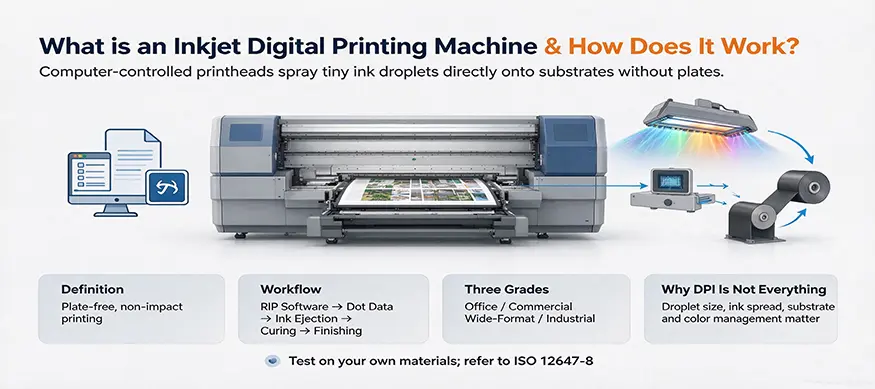
An Inkjet Digital Printing Machine is a type of computer-controlled printer that uses exact printheads to spray a medium with tiny drops of ink. "Non-impact printing" is the name of the method because the paper is not pressed against anything. The steps are easy to see. Artists' work is turned into dot data by RIP software. Ink is then sent to the printheads by a transportation device, which moves the paper over them. The heads make droplets, and a heater or fixing unit sets the ink. The tape is then checked, die-cut, or started over many times. Nothing is made by hand, so you can change the file between jobs without having to make new tools. This makes the tech good for tag shops, factories that make lots of different things, and converters.
Office, Commercial, and Industrial Classes
It's not true that all Inkjet Digital Printing Machines work well in factories. Small amounts of paper are handled by light-duty office tools. Most business wide-format printers have a scanning carriage that lets them make images for signs, posters, and ads. They can work with rolls or stiff parts, and they can connect to unwinders, curing units, and finishing tools. Machines in plants work long shifts. Some of the things that make them stand out are their duty schedule, material range, automation, and service access. Don't just look at the print width when you compare quotes. Check to see how long the machine's maker says it can run. Label printers that work eight hours a day need lots of ink and strong parts, which aren't always available in cheap desktop printers.
Why DPI Alone Does Not Show Quality?
People who are interested see that number first, but it doesn't say everything. Not only does dots per inch (DPI) show how good something is, but droplet size, printer performance, ink spread, substrate coverage, and color management are also really important. They can print on the same film in different ways, even though they both have the same DPI. To do this, standards are useful. In ISO 12647-8, process control is discussed as a way to make sure that digital print processes that start with digital data are safe. Ask suppliers to print some of your own materials for you to look at. After that, check a whole roll to see if the small text, barcodes, and color scheme are all the same. A group that you can count tells you more about the truth than a brochure number.
What Is an Inkjet Digital Printing Machine Used For in Real Production?
Self-Adhesive Labels, Stickers, and Roll Products
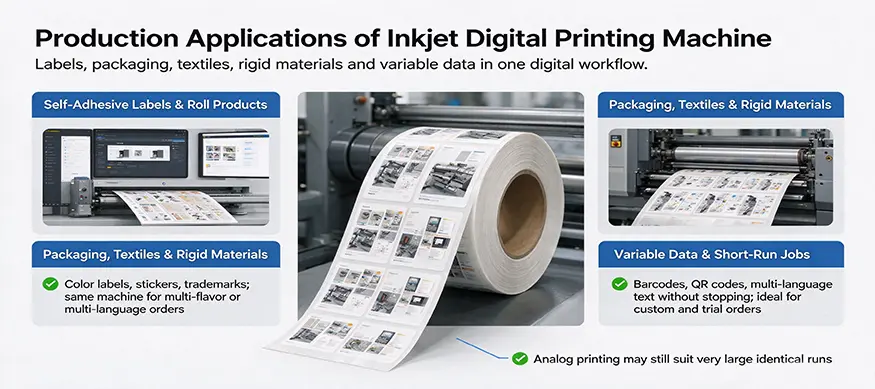
Labels work best. With a roll-to-roll Inkjet Digital Printing Machine, you can make self-sticking labels, stickers, trademarks, color labels, and other roll goods from a digital file. A food company with six flavors, a makeup company with versions in different languages, or an electronics company with labels for each model can all use the same print run. Since there are no plates, a new design starts to print as soon as the file is ready. First, look at four things: the width of the print, the diameter of the roll, the thickness of the material, and how the print is dried. You can tell if your labels will make it by these four things. I'll talk about a machine made just for this job later in this book.
Packaging, Textiles, and Rigid Materials
The main technology of an Inkjet Digital Printing Machine isn't just for signs. Inkjet Digital Printing Machines can print on paper bags, vinyl films, folding cases, and cardboard boxes. Clothes, wood panels, ceramic tiles, and metals that have been coated can be decorated with different shapes. Our tests see how well the ink sticks to films, soaks into paper, dries on fabrics, and holds up to heat on ceramics. Flex webs work best with roll-fed machines, while hard panels and boards work best with flatbed machines. Checking how well ink sticks to a surface with the ASTM D3359 tape test is a simple way to find out. It is also important that the print width works with the machine that does the converting. Make sure the machine fits the material before you decide anything else.
Variable Data and Short-Run Production
You can change the text on one label to something else without stopping the line because variable data printing doesn't need to. Codes, barcodes, QR codes, and words that can be read in more than one language are all in the digital file. This helps people who sell their goods at more than one market, make unique items, or test an idea before making a lot of them. When there are no plates, it takes less time and less trash to set up. Short runs that used to seem too expensive to be worth it can now be done. People who want to buy from me should be honest about how much they need: analog presses might still be better for making a lot of the same thing. The best one will depend on how long the job takes and how often the art needs to be changed.
Types of Inkjet Digital Printing Machines and How They Compare
Single-Pass, Scanning, Roll-to-Roll, and Flatbed
Architecture affects how fast and easily something can be changed. It only goes under the set of printheads one time in single-pass Inkjet Digital Printing Machines. This lets a lot of things run through and keep making things. Scanning machines have a frame that moves over the media more than once. These machines are good for flexible, low-volume work. It is also important to format. Label stock and film are moved from an unwinder to a rewinder by a roll-to-roll machine. On the other hand, a flatbed machine works with parts and boards that are stiff. Signs and pictures look best printed on wide-format printers, and industrial platforms let you print more jobs at once, automate tasks, and get service quickly. Not the name with the biggest number on the sheet, but the design that works for your job and the materials you have on hand.
UV, Water-Based, and Eco-Solvent Inks
Things like where it can be put and how long the print lasts are important. When UV light hits UV inks, they dry. They stick to a lot of smooth surfaces and are often used for signs. Inks that are based on water work well on porous paper and fabrics. The dyes dry through heat or absorption. If you let the inks dry on their own, they can be used to print signs and graphics on vinyl and coated media. LED lights, regular UV lamps, or hot air dryers can be used to dry the ink. There are also rules about how to handle food, how the surroundings should be, and how strong an odor can be. Always make sure that the ink works with the printheads, and test it on your own stuff.
Compared With Offset, Flexography, and Laser
There's a good spot for every tech. Offset is still a good choice for very big standard runs. Flexography is great for packaging a lot of items that need to be done over and over, but it needs plates and time to set up. They work well for office work and some business tasks. Industrial Inkjet Digital Printing Machines, on the other hand, can print on more types of media and keep going without stopping. With inkjet, you don't have to prepare the plates, and the data can be changed, so it can handle short jobs that change often. Look at more than just the price when you own something. It may be more expensive to buy a cheap machine that stops a lot than a better one that keeps going. This is due to the fact that fixes, downtime, labor, service, and ink all add up.
Shanghai Honghua Label Inkjet Digital Printing Machine: Specifications and Features
Core Specifications
Stickers, color labels, roll products, and labels that stick on their own can all be used with our plate-free, roll-to-roll Inkjet Digital Printing Machine. It can hold things that are 75 mm to 350 mm wide and 0.02 mm to 1 mm thick on rolls that are up to 800 mm in diameter. You can print on pages as wide as 322 mm with CMYK four-color printing, and you can use TIFF or PDF files. It's 2 m long, 1.5 m wide, and 1.9 m high, and it weighs 1,500 kg. It works on 380V AC at 20 kW and needs industrial air at 0.6 to 0.8 MPa. LED and regular methods are both used for curing. Make sure there is enough space, power, and airflow before you place your order. You can also talk to our team about how to change the power to 110V, 220V, or 380V so that it works with your electric grid.
Features That Protect Print Quality
These are the most important things in a business.
- Registration and overprinting: The machine can print on both the front and back in any color, and the built-in printing unit can repeat position accurately within 0.005 mm. All of these features work together to help people who make labels print on both sides, add more color layers, or make sure that each print pass lines up perfectly with the one before it.
- Ink and printhead protection: To protect the ink and printhead, the special ink circuit goes into holiday mode within one minute of the power being turned off, and a full-circuit ink temperature control system starts at the main ink tanks. The unique slit LED technology stops light from leaking, which keeps the printheads clean. Additionally, automatic foreign object detection keeps them safe.
The base plate is made with great care and has been heated several times to make sure it will never bend. There is a patent on binding technology that lets you print without lines showing. Many times, label shops have issues with wrong registration, clogged heads, and downtime after long periods of not being used. These features make those problems go away.
Delivery, Support, and Customization
The machine is made to last 20 years, and customer service is free for life. We have many plants in China so that we can serve you quickly. We also have many warehouses in Southeast Asia, which makes it easy to move goods between countries. All of our products are made with a lead time of about 60 days. We offer a 12-month warranty, technical support, remote help, and support for spare parts. Any freight forwarder you want is fine with us. We accept FOB (Shanghai/Ningbo), CIF, and DAP terms. Strong wooden cases that have been fumigated and layered with shockproof foam are used for export. The printheads and servo motors move around in their own wooden boxes that are sealed to keep out water. All of our tools have PLC systems that work with systems from other countries. We offer free customized solution drawings and don't have a minimum order size, so you can order just one unit.
How to Choose and Buy an Inkjet Digital Printing Machine?
Define Your Production Requirements First
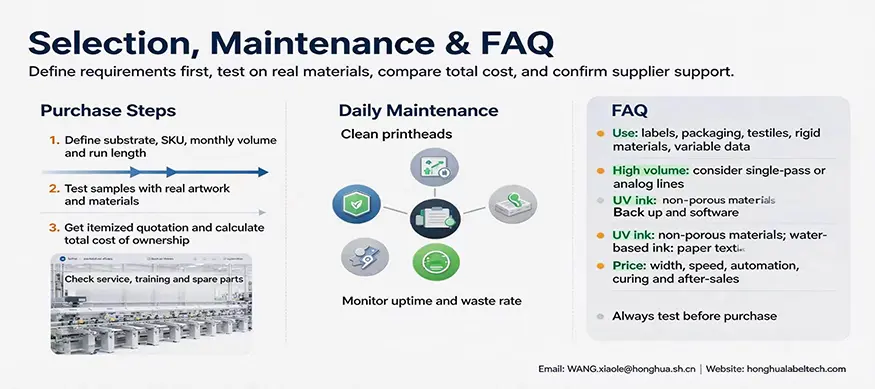
To begin, what sort of base do you need? To make your Inkjet Digital Printing Machine last as long as possible, write down the SKU count, the print width, the monthly volume, and the average length of a job. Finally, pick whether you want a machine that feeds itself automatically or by hand, a roll-to-roll or sheet machine, or one that makes a single pass or a scan. The engineering teams should also make a list of services, such as the types of files, electricity, airflow, and floor space. The procurement team can add the budget, the date of delivery, and the country where the goods will be sent. This list helps you find a system that meets your exact needs. Along with that, it helps the seller suggest the best setup instead of a standard one.
Test Samples and Compare Total Cost
Do not buy based on the title alone. Send in your real work and information first for a test run. Then, check the whole roll to make sure the colors are correct, the ink sticks well, it cures, the barcode can be read, it registers, and it stays stable. Get prices that show how much the base machine, the RIP software, the ink system, the sealing equipment, the training, the installation, the warranty, the extra parts, the shipping, and the training all cost separately. That way, you can look at packages that are the same. When you buy used things, check the printheads, ink lines, and moving parts, and make sure the seller can show you proof that they have been used. When you buy OEM or changed systems, make sure you get written proof of every change. When you own a printer, you have to pay for things like ink, fixes, downtime, work, and service.
Maintenance Habits and Supplier Support
Print quality changes when it is cared for regularly. If the nozzles are blocked or not lined up right, uneven or thick ink, dust, bad handling of the media, or weak curing are the main things that can go wrong. Check the ink and clean the needles every day. Set up regular times to back up software, adjust, and check filters and pumps. Keep an eye on uptime, waste rate, changeover time, and cost per printed unit to quickly find problems. That the supplier can help you is also important, so find out about things like training, spare parts, online help, and response times. Wholesalers and private-label partners can get technical help from Shanghai Honghua. They also share technology and offer on-site technical support. They do OEM and ODM work as well.
Conclusion
By printing directly from a digital file, an Inkjet Digital Printing Machine can do away with plates and long setup times. It can be used for jobs with variable data, labels, flexible packaging, cartons, textiles, jobs with rigid materials, and jobs with variable data. Where a system works well depends on its type of machine, design, media type, and ink chemistry. DPI doesn't tell you much about quality on its own. When it comes to short, changing, or one-of-a-kind jobs, inkjet works better than offset, flexography, and laser. The analog way might still be better for making a lot of the same thing. It's important to have clear requirements, real-substrate tests, itemized quotes, and know the total cost of ownership before you buy something. Printers stay up and running and print well when they get regular maintenance and strong help from the service provider. The label system shown here shows how important it is to know about width, curing, and registration in real life.
FAQ
What is an Inkjet Digital Printing Machine used for?
It doesn't use plates to print labels, packages, fabrics, wood, ceramics, or data that changes; it does it all from digital files.
Is it suitable for high-volume production?
When you need to do a lot of work, single-pass platforms are better. When you need to be flexible and do less work, scanning systems are better. For making a lot of the same thing, analog presses might still be better.
How do UV and water-based inks differ?
UV light sets the ink, and it sticks to many objects that don't have holes. That's because porous things will soak up water-based ink and dry it either through heat or absorption.
Why do machine prices vary?
The price is different for each print width, speed, architecture, automation, curing, software, and customer service.
Should I test before buying?
Yes. First, look over the art and real materials. The next step is to check the color, registration, adhesion, curing, and barcodes.
Request an Inkjet Digital Printing Machine Recommendation from Shanghai Honghua
Want to buy an Inkjet Digital Printing Machine from a business that cares about its customers? OEM and ODM services are available at Shanghai Honghua. They also offer a 12-month warranty and free professional help for life. We need to know the type of paper, print width, monthly quantity, ink choice, automation needs, and target country when you email us at [email protected]. We'll get back to you with ideas on how to set up, a sample test, or a full quote. Find out more about the item at honghualabeltech.com.
References
1. Handbook of Print Media, 2001
2. Handbook of Industrial Inkjet Printing, 2017
3. Inkjet Technology for Digital Fabrication, 2013
4. ISO 12647-8: Graphic Technology, Process Control for Validation Print Processes Working Directly From Digital Data, 2021
5. ASTM D3359: Standard Test Methods for Measuring Adhesion by Tape Test, 2023
6. Digital Printing of Textiles, 2006